
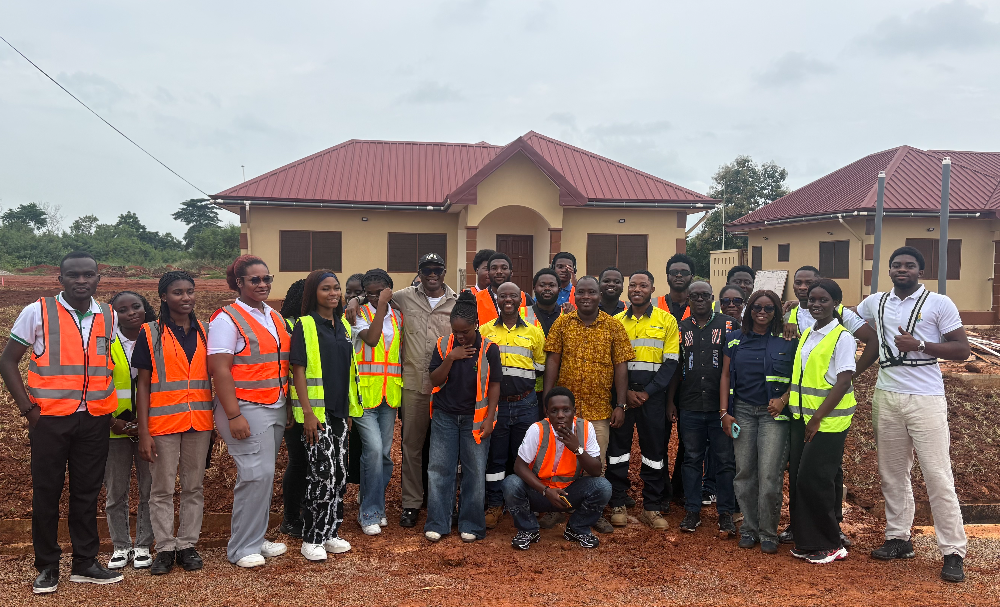
The Department of Land Economy at the College of Art and Built Environment (CABE) of the Kwame Nkrumah University of Science and Technology, Kumasi (KNUST) has organised an educational field trip to the Newmont Ahafo North Mining Project near Sunyani to provide students with practical experience in land acquisition, valuation, compensation and resettlement within Ghana's mining sector.
The field trip, organised for third-year Bachelor of Science students in Land Economy and Real Estate, aimed to bridge the gap between classroom instruction and professional practice by enabling students to observe how concepts taught in lectures are applied in mining operations.
Conducted in two phases, the visits took place on July 16, 2026, for Land Economy students and July 23, 2026, for Real Estate students. The exercise was led by the Head of the Department of Land Economy, Professor Joseph Kwaku Kidido, with support from faculty members and teaching assistants.
The students were received by Newmont Ghana's Land Access and Social Responsibility Team, led by Surveyor Matthew Oppong, who introduced them to the company's approach to land access and stakeholder engagement under the Ahafo North Mining Project.
During interactive presentations, the team discussed land acquisition processes, compensation negotiations, resettlement planning, housing design and livelihood restoration programmes for project-affected communities. The sessions gave students practical insights into the legal, technical and social dimensions of land administration in the mining industry.
As part of the exercise, students visited the resettlement communities of Afrisipakrom and Terchire in the Tano North Municipal Assembly of the Ahafo Region, where they observed ongoing housing and infrastructure developments for displaced households.
The visits enabled students to inspect construction works, architectural designs and civil infrastructure while gaining first-hand understanding of how resettlement programmes are implemented to improve the living conditions of affected communities.
According to the Department, the resettlement projects provided a valuable case study of how stakeholder engagement, negotiated compensation and coordinated planning can support involuntary resettlement while safeguarding the interests and livelihoods of project-affected people.
The Department said Newmont's resettlement communities, developed using modern construction methods and supported by essential social infrastructure, demonstrate how collaborative planning can contribute to improved housing and community development.
The field exercise forms part of the Department's commitment to producing industry-ready graduates by exposing students to professional practice throughout their academic training.
The Department also acknowledged its longstanding partnership with Newmont Ghana Gold Limited, describing the collaboration as instrumental in enriching teaching and learning through practical industry engagement.
Over the years, the company has consistently provided opportunities for students to gain first-hand experience in land access, compensation and resettlement practices within the mining sector.
The Department expressed appreciation to Newmont Ghana Gold Limited for its continued support and reaffirmed its commitment to strengthening the partnership to equip future land professionals with the practical knowledge and skills required to support Ghana's mining industry and broader land administration sector.
Story: Erica Boateng


